Retaining Walls in Newcastle
NSW classes a retaining wall as structural landscaping, work on an external landscape feature that is not a habitable building, and that classification sets its licence threshold whatever the material. Over A$5,000 in labour and materials including GST, the job needs a NSW contractor licence. From there, what decides the paperwork is which local body has to look at it: City of Newcastle, Subsidence Advisory NSW, or in most small jobs, neither.
Thanks — we have your enquiry. Someone will be in touch shortly. Prefer to talk now? Call (02) 4915 2985.
What retaining wall work in Newcastle actually involves
The Home Building Regulation 2014 lists structural landscaping as its own category of residential building work and defines it to reach “retaining walls of any material that do not form part of a habitable building”. Building Commission NSW states the threshold in plain terms: a licence is needed once work is valued at more than $5000 in labour and materials including GST, the amount clause 12 of the Regulation fixes as the prescribed amount.
Why a garden wall can be building work
A wall put up to support a house, or drainage built to keep water off a wall's footings, is not treated as a separate landscaping item: the law folds it into the dwelling itself. Once it is part of the dwelling, building it, fixing it or rebuilding it is residential building work, the same legal category as any other renovation.
Building it yourself
Doing the work yourself changes this rather than avoiding it. Supervising or building it without a licensed builder to supervise needs an owner-builder permit once the value passes A$10,000, and the permit applies only where the job also needs a development application or complying development certificate. Past A$20,000 you also need the relevant units of competency or an equivalent qualification.
Staying under the exempt-development limits
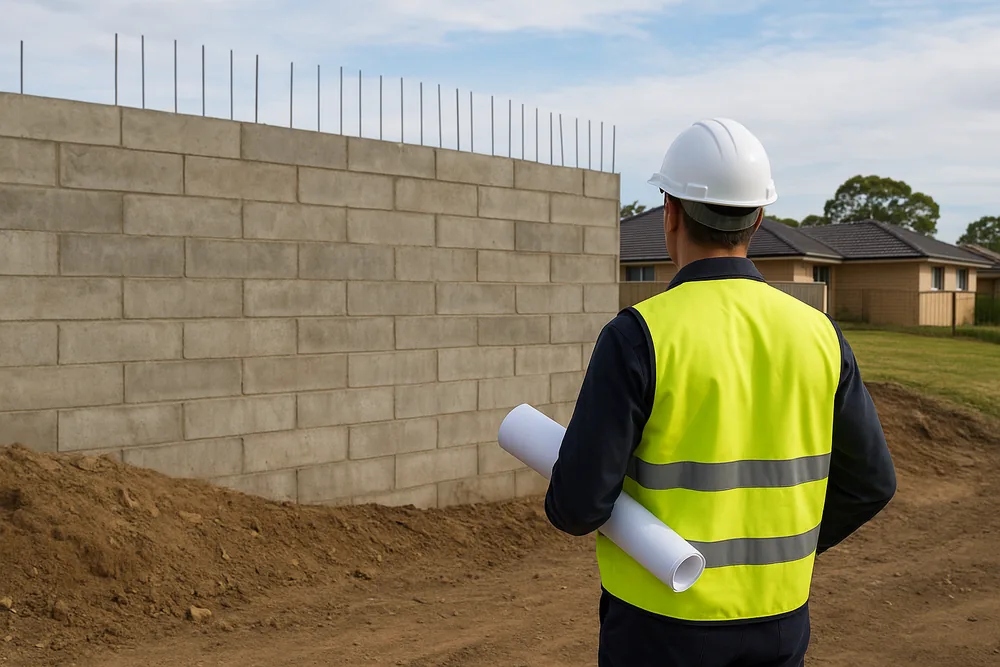
A wall can go up with no planning approval only if every one of these holds, all at once: no more than 600 mm high, measured from its base to its top; at least 1 m from each lot boundary; at least 2 m from any other retaining wall on the site; at least 1 m from a registered easement, sewer main or water main; at least 40 m from a natural waterbody; and with drainage connected to the site's stormwater system and not redirecting water or sediment onto a neighbour. It also cannot sit on a heritage item, a flood control lot or environmentally sensitive land, and it must meet the Building Code of Australia or otherwise be structurally adequate. Miss any one of those and the wall is no longer exempt.
When City of Newcastle needs to see it
City of Newcastle says a wall that exceeds the exempt-development standards needs consent before it is installed. The Codes SEPP defines detached development as any of a list, among them “(k) retaining wall”, if it is “situated more than 900mm from a building that is residential accommodation to which it relates”, and makes “the erection of detached development” complying development, which is the route the Housing Code in Part 3 of that Policy sets out. Otherwise the route is a development application assessed against the Newcastle LEP 2012 and the current Newcastle DCP. Whichever route it takes, the work must be structurally adequate, installed to the manufacturer's specifications and comply with the Building Code of Australia.
In a Mine Subsidence District
Parts of the area have been affected by underground coal mining or sit within the zone of influence of old workings. If your address is in a district, you need Subsidence Advisory NSW's approval before building or subdividing, unless the work is explicitly listed as exempt. Its exempt list allows “Retaining walls 1 m high All”, and demolition is separately listed as exempt. Each property in a district carries its own guideline and neighbouring properties can carry different ones, so use the NSW Planning Portal's Spatial Viewer to check yours, since the district maps only give a general overview. On properties assigned Guideline 2, 3, 3A, 6 or 8, the council or an accredited certifier can approve a compliant application directly; on Guidelines 1, 1A, 4, 5 or 7, Subsidence Advisory's own approval is required. Where a development application needs that approval, City of Newcastle's plan requires the stamped, endorsed plans to be lodged with it. All homes and buildings in NSW, inside or outside a declared district, remain eligible for compensation if damaged by mine subsidence, provided the correct approvals were obtained.
Any structure on or over public land or a road needs its own approval from Council or Transport for NSW under the Roads Act 1993 and the Local Government Act 1993, so a wall that touches the verge is a different job from one wholly inside the lot.
Retaining wall costs and rules check
Retaining Walls in Newcastle — common questions
Does a retaining wall need a licensed contractor?
Over A$5,000 in labour and materials including GST, yes: a retaining wall not part of a habitable building is structural landscaping work, and the contractor needs a NSW contractor licence.
Can I build one without council approval?
Only within the exempt limits: no more than 600 mm high, at least 1 m from each lot boundary and clear of easements, sewer and water mains, and not on a heritage item or flood control lot.
Do I need Subsidence Advisory NSW as well as Council?
If your address is in a Mine Subsidence District, yes, unless the work is on Subsidence Advisory's exempt list, which allows a retaining wall up to 1 m high. Check your address on the Spatial Viewer.
Retaining Walls by suburb
- Retaining Walls in The Hill
- Retaining Walls in Cooks Hill
- Retaining Walls in Kotara
- Retaining Walls in Minmi
- Tighes Hill
- The Junction
- Merewether
- Adamstown
- Lambton
- New Lambton
- Wallsend
- Mayfield
Ready to get your retaining wall work job quoted?
Free quote, one local provider, no obligation.
Last reviewed · Updated · First published